TALLAHASSEE, Fla. — Progressive candidates scored two victories in Tuesday’s city elections, giving the progressive bloc a 3-2 majority on the Tallahassee City Commission and potentially shifting the direction of city government on issues ranging from development and affordable housing to utility rates and city spending.
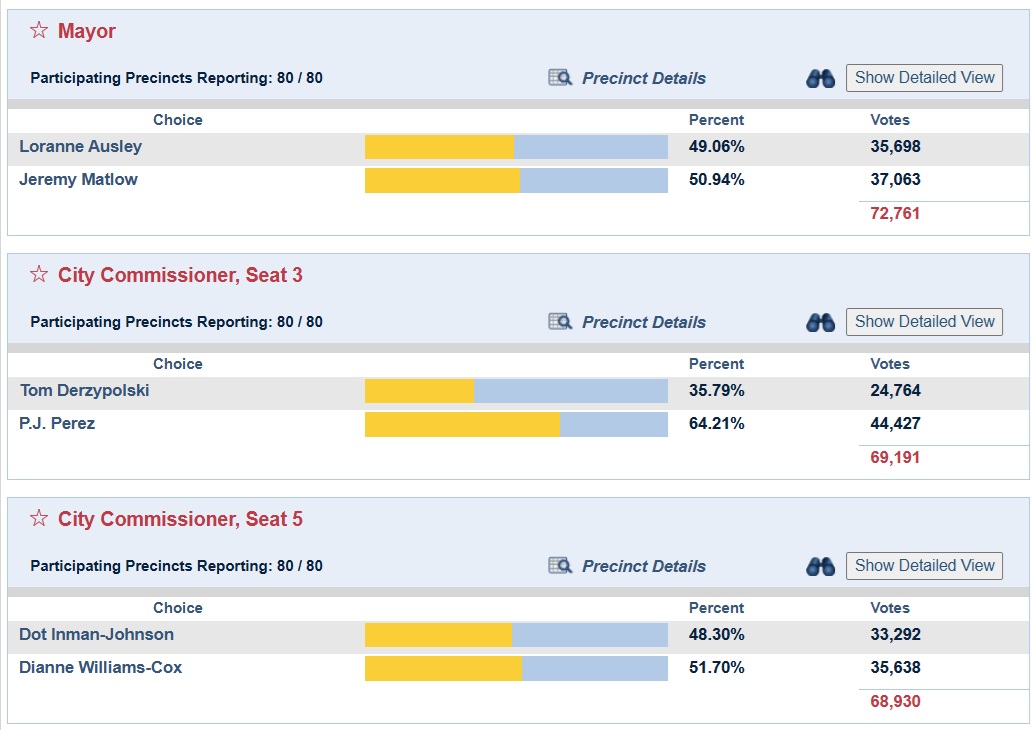
Mayor Jeremy Matlow defeated former state Sen. Loranne Ausley in a close contest, receiving 37,063 votes (50.94%) to Ausley’s 35,698 votes (49.06%). Matlow’s margin of victory was 1,365 votes out of 72,761 cast.
In the City Commission Seat 3 race, progressive candidate P.J. Perez defeated Tom Derzypolski by a substantial margin, receiving 44,427 votes (64.21%) compared to Derzypolski’s 24,764 votes (35.79%).
However, progressive candidate Dot Inman-Johnson was unsuccessful in her attempt to unseat incumbent Commissioner Dianne Williams-Cox in Seat 5. Williams-Cox received 35,638 votes (51.70%) compared to Inman-Johnson’s 33,292 votes (48.30%), a margin of 2,346 votes.
With all 80 precincts reporting, the results establish a progressive majority consisting of Matlow, Perez and Commissioner Jack Porter. Williams-Cox and Commissioner Curtis Richardson will represent the minority bloc.
The new alignment could have significant implications for city policies and spending priorities.
During the campaign, progressive candidates emphasized affordable housing, government accountability, environmental protection and changes to the city’s approach to growth and development.
With three votes, the progressive majority could advance policies that previously faced resistance, including additional development regulations, changes to utility policies and greater scrutiny of city spending and economic development incentives.
The majority could also influence appointments to city advisory boards and the selection of leadership positions, while potentially revisiting decisions made by previous commissions.
One area to watch will be the city’s relationship with developers. Matlow and Porter have frequently challenged development proposals and policies they contend favor developers over existing neighborhoods. Perez’s election provides another potential vote for that approach.
Utility rates and the city’s electric utility investments could also become contentious as commissioners consider future energy projects and their financial impact on customers.
However, campaign promises will now face the practical challenges of governing, including budget limitations, existing contractual obligations and competing demands for city services.
For Matlow, Porter and Perez, the challenge will be translating their campaign positions into governing decisions while demonstrating that their policies can deliver measurable results for city residents.